
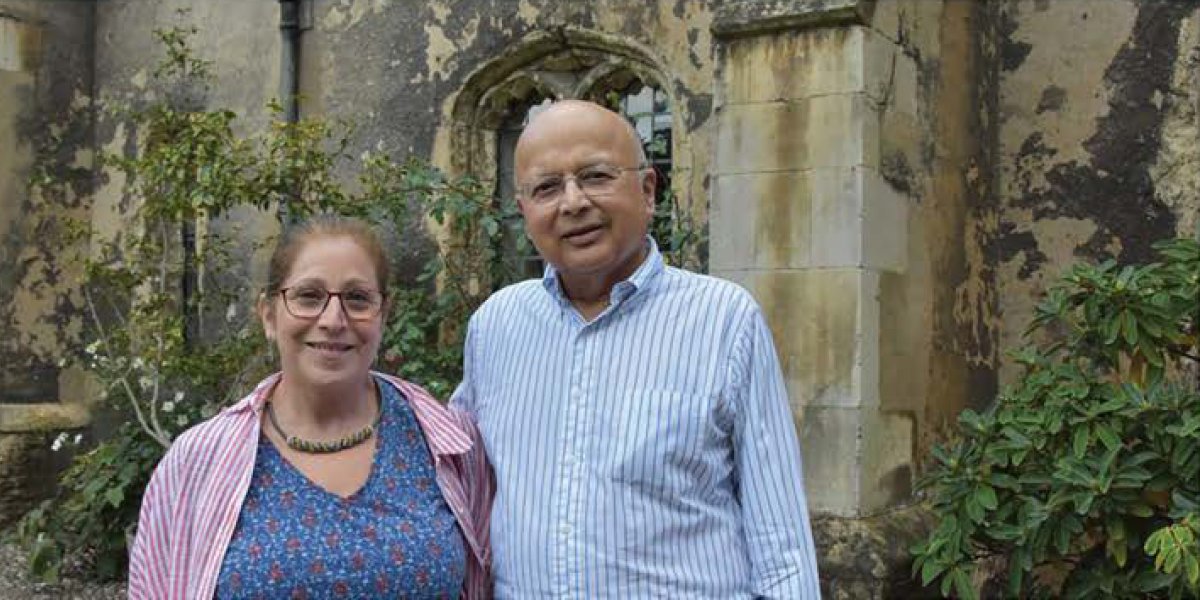
Renowned Economist and 1209 Society Member Avinash Dixit (Corpus Christi 1963): In His Own Words
Photo: Professor Avinash Dixit (Corpus Christi 1963) and partner Toni Adlerman
When Avinash Dixit, the John J.F. Sherrerd '52 University Professor of Economics Emeritus at Princeton University was inducted as Honorary Fellow of Corpus Christi College eight years ago, he shared a brief essay on his experience, describing his time as an undergraduate student at Corpus Christi College.
The thoughtful, witty, and tender reflections (excerpted below) speak to his deep affection for Cambridge and highlight his gratitude by making an estate commitment through his retirement plan. As was the case for Professor Dixit, retirement assets are one of the most popular planned gifts among academics, teachers, health professionals, government workers, and others. IRAs, 401(K)s, and other retirement assets can be heavily taxed when left to heirs, but charities can receive them taxfree-making them one of the most tax-efficient assets to give.
Professor Dixit's Memories of Corpus in the mid-1960s
My visit to Corpus Christi College in 2018 for admission as an Honorary Fellow began, alas, with my least favorite memories from my undergraduate days. I arrived on a Sunday morning to relentless rain and the bells of St. Benet's church ringing right outside the guest room on Z staircase where I was to stay. In my first year as an undergraduate (1963-4), I lived in the room at the top of that staircase, and those very bells woke me up every Sunday morning. In my second year I was fortunate to move to E staircase. Church bells sounded much more pleasant at that distance!
The rest of my memories are likewise very pleasant. Even the quirks of British life and college life at that time - for example, the need to keep a good stock of shilling coins to feed the meter for the gas fire in my room - become pleasant in retrospect. I left with a treasure of these memories - and the Bishop Green Cup, which still stands in my display cabinet.
Those years were instrumental in setting me up for a decades-long career.
It was an extraordinary pleasure and privilege for me to receive an Honorary Fellowship of the College. And it is now my honor and pleasure to make the College a beneficiary for a part of my estate.
After more than thirty years as a distinguished professor at Princeton and a trajectory which includes the publication of several transformative texts on economic theory, Professor Dixit expressed his gratitude to Corpus and Cambridge by naming CAm as a partial beneficiary of his retirement accounts and joining both Cambridge in America's 1209 Society and Corpus Christi College's 1352 Foundation Society.
We asked Dixit a few questions about his journey from Bombay to the apex of American academia and his desire to support Cambridge.
What led you to study at Cambridge?
At the time I was an undergraduate in India in the early 1960s, majoring in mathematics, it was just the thing to continue one's studies at Cambridge if possible. [The great English mathematicians] G.H. Hardy (Trinity 1896) and J.E. Littlewood (Trinity 1903) were godlike figures in math, and the legendary mathematical genius Srinivas Ramanujan (Trinity 1914) also meant a lot in India. I had done very well in math in Bombay; on my final graduation exam I scored the full 600/600, which had never been done (although I understand it has been a few times since).
My father (a physics professor in Bombay) also studied in the U.К. (at Imperial College, London, where he got his Ph.D.), which reinforced my decision. He advised me to apply to Corpus, where his own teacher, the Nobel Laureate physicist George P. Thomson, had become Master.
How did your time at Cambridge shape your career?
In those days applications of mathematics were mostly in areas like physics and cosmology. I wanted to try something different. Some friends reading economics at Corpus told me that mathematics was proving increasingly useful at research levels in their subject. went for advice to Andrew Bain, the economics Fellow at Corpus (a distinguished monetary economist, later professor at the University of Stirling and an adviser to the government and banks). He told me to read Paul Samuelson's Foundations of Economics Analysis, and Gerard Debreu's Theory of Value. The recommendation worked perfectly; both books got me hooked right away. I decided to go to graduate school in economics. Again, Bain's advice was perfect: apply to MIT and Princeton. I got my Ph.D. from MIT (1965-68) and was on the faculty for thirty years (1980-2010) at Princeton. So, in a sense Corpus should get all the credit for such career success as I have had.
Why is it important for you to make a gift to Cambridge in America?
Given the important influence of Cambridge-and Corpus Christi College in particular-on my career I thought it was not just proper, but a pleasure to give back.
Why did you decide to make a planned gift via a beneficiary designation of retirement assets?
Because that's where the bulk of my money is! Seriously, of course I give smaller sums in cash transfers every year as annual gifts, but for a much more substantial sum, this was the best way for me to give.