
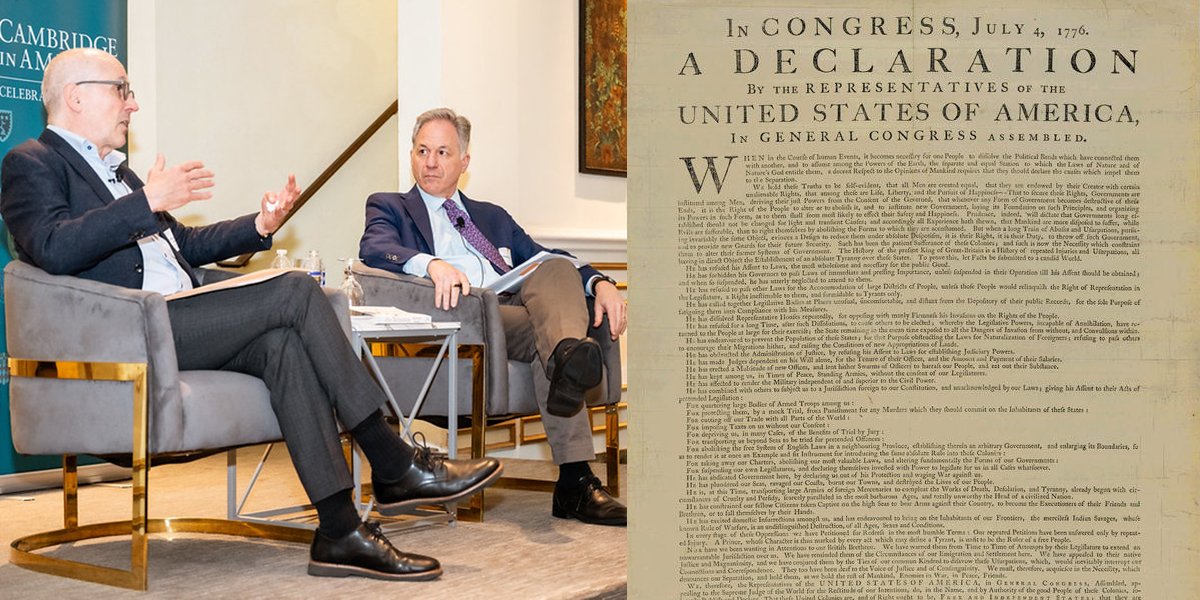
The Declaration of Independence: its Resonance and Relevance Then and Now
The Declaration of Independence was announced on July 4, 1776. The words in that document were not only profoundly controversial but spoke to Americans already in the grip of violence and upheaval.
“This is the background: there's a war going on, there are soldiers dying on both sides,” said Gary Gerstle, Paul Mellon Professor of American History Emeritus at Cambridge, as he began a wide-ranging discussion on this defining document with Free Press columnist, journalist Charles Lane. The two engaged in a conversation titled, Does the Declaration Still Resonate? A 250-Year Reflection in Washington DC on April 15th at an event sponsored by Cambridge in America. The talk explored the 18th Century context of that world-changing page of history, what it meant then, what it’s meant throughout the nearly 250 years of the American experiment, and how the understanding of its meaning has shifted and transformed.
Gerstle noted that setting the stage for the Declaration of Independence was another pivotal document published six months earlier in January 1776, Thomas Paine’s Common Sense. “This pamphlet sold hundreds of thousands of copies in a society with a population of only three or four million people and was passed from hand to hand. It had a profound impact in shaping the discourse that enabled a group of very elite and wealthy men, the writers of the Declaration of Independence, to think originally and creatively about what they were doing,” said Gerstle. “Paine wrote it's a matter of ‘common sense’ that people should be ruled by those whom they consent to be ruled by.”
The 250th anniversary offered an opportunity for Gerstle and Lane to interrogate the forces that inspired the writers of the Declaration of Independence, especially considering how heavy a price they paid for putting their case for an independent America into words and on the page.
By the time the document was penned the founders “have been expelled, excommunicated from the Empire, which means not only are they not going to be protected any longer by Britain, they will be subject to the full fury of the British Empire, which means they can be tried, they can be jailed, they can be killed. Moreover, things are happening so fast with this new notion of all men are created equal in a world of profound inequality. They don't know what kind of government they're going to create,” Gerstle explained. “Is it going to be a republic? Is it going to be a democracy--a dirty word in the 18th century, because it meant, following the ancients, the rule of the mob. They simply didn't know what was coming.”
The deep dive into the life and times of the Declaration of Independence surfaced traceable threads to divisive issues that have withstood the centuries.
“There was a paradox right there in the document, between the words ‘all men are created equal,’ and the blatant fact that slavery was practiced on a large scale by the very author of this document, Thomas Jefferson,” said Lane. “Nevertheless, he included some scathing language about the transatlantic slave trade.”
However, that section of the original draft — Thomas Jefferson’s case against slavery — was cut by a group of editors known as the Committee of Five. Gerstle and Lane also noted how the US Declaration inspired other national anticolonial movements and how the promise that “All men are created equal,” has in many ways failed to deliver.
“Is there a way to revive the meaning while acknowledging all the flaws and salvage legitimacy of the project?” Lane asked.
Gerstle’s reply brought the relevance of the Declaration of Independence then and now into sharp relief, perhaps answering the question posed by the event’s title.
“One of the greatest concerns of the founders was, how do you guard against exaggerated executive power? How do you ensure that the people continue to be sovereign? This was something they gave an extraordinary amount of attention to, and I think we would benefit not from saying those grievances are gone, but that they're newly relevant. In this era where democracy is on the defensive, I think some of what was discussed in the late 18th century and into the early 19th century is newly relevant and may have purchase.”