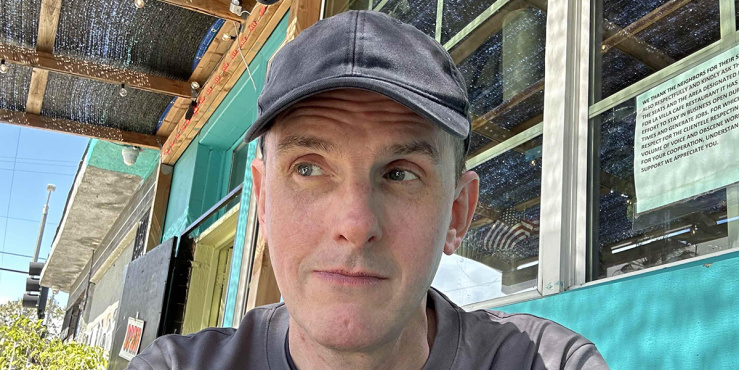
From undergraduate studies in literature to a professorship in North American history, Nick Guyatt has built a career exploring the forces that shaped the United States. He shares insights into his work and CUSAC, a new Cambridge initiative designed to connect scholars and broaden understanding of America’s global role.
When Nick Guyatt (Emmanuel 1992) first came to Cambridge as an undergraduate, he majored in American Literature. The more he learned about American history through the lens of its writers, the more he wanted to know about America’s past. This led him to pursue an MPhil in Political Thought and Intellectual History at Cambridge, and then a PhD in History at Princeton University in New Jersey.
Today, as Professor of North American History and Fellow of Jesus College, Guyatt draws on a scholar’s deep well of knowledge about the events and leaders that have shaped the United States. He also draws on his own experience of spending nearly a decade living here, along with multiple visits every year since he first came to America in 1994.
This month Professor Guyatt is leading a discussion for Cambridge alumni, in partnership with Cambridge in America. The event, entitled What Donald Trump gets right (and wrong) about the Monroe Doctrine, takes place as the US pursues a contentious war with Iran. In advance of that event, Professor Guyatt sat down with us for a conversation about his career, his research, and about the Centre for the United States of America at Cambridge (CUSAC) – a new initiative advancing fresh perspectives on U.S. history, culture, and global influence.
What led you to pursue the study of American History?
I think people sometimes expect there to be a quirky or personal answer, but honestly, if you grew up outside the US in the 1980s and 1990s, the country was simply everywhere: The end of the Cold War, the 1991 Gulf War, what Charles Krauthammer called the “Unipolar Moment,” Francis Fukuyama’s idea that history had ended and we were now living in an American world. You didn't have to be a nerd to be fascinated by it. Everyone everywhere had a stake in the United States.
You’re one of the driving forces behind CUSAC — the Cambridge United States of America Centre — a new interdisciplinary center that aims to make Cambridge the world's leading institution outside the U.S. for understanding America. Why does Cambridge need a dedicated center for U.S. studies — especially now?
Well, given the turbulence in American politics and foreign relations, we think it’s more important than ever to maintain and deepen connections between the U.S. and the rest of the world. In that sense, we may be running towards the fire while others are running in the other direction – but wherever the world is headed, we’re convinced that a deeper and fuller knowledge of the United States is going to make the journey easier.
And our interest in North America runs pretty deep. Cambridge has an extraordinary history in that regard which stretches back nearly 150 years before the Declaration of Independence. In 1630, the ship Arabella arrived in Massachusetts Bay carrying John Winthrop and a group of people who helped found New England and the model of constitutional governance that eventually shaped the United States. Winthrop studied at Trinity; so did John Cotton, who came over in 1633. John Eliot, the pioneering missionary to the Indians, was a graduate of my current college, Jesus. And of course, John Harvard, whose bequest helped to create Harvard College, was a graduate of my undergraduate college, Emmanuel. We have been in this game, in a sense, for nearly 400 years.
More recently, thanks to the gifts which created the Pitt Professorship of American History and Institutions in 1948, and the Paul Mellon Professorship of American History in 1980, Cambridge has built the largest community of American historians outside the United States. Our hope for CUSAC is that it can connect those historians with the dozens of remarkable people working on the US across other Cambridge departments and faculties – in Law, Sociology, Economics, Politics, Literature, the Bennett School of Public Policy, the exciting new Rokos School of Government — and bring all of these brilliant minds into dialogue with scholars and policymakers from the US and the rest of the world.
What will CUSAC actually do — concretely?
Three things. First, we want to give our existing scholars — and, again, there are more people working on the US at Cambridge than at any other university outside America — the spaces, resources, and pretexts to collaborate far more than they currently do. Second, we want to bring outstanding people to Cambridge from the US and around the world - from postdoctoral fellows to visiting academics, policymakers, journalists, and artists – and put them to work on specific problems that we commit to trying to solve over four-year cycles. At the end of each cycle, we produce concrete findings — not just academic papers, but something we can put our names on and hand to policymakers, our supporters, and to the public.
And third, public engagement, including major public events. This year’s 29 May event, “America at 250”, is the model — bringing together Pulitzer Prize winners, legal scholars, poets, historians, journalists, and politicians to reflect on the legacy of the Declaration of Independence and to ask if the Declaration still matters today. Events like these rewire our thinking and foster conversations that couldn't happen in a journal article or an academic seminar. And we're already planning a follow-up event in the autumn on an equally important topic: “The past, present and future of American journalism.”
You're giving this talk to an American audience at a time of high political tension. What do you hope they take from it?
The great privilege of being a historian is that you can take a step back. I have my own political views, of course, but I find it genuinely easy to say: let's line up what happened, think about what it meant, and then have a conversation in which your conclusions are as valid as mine. I'm not there to tell anyone what to think or to do.
What I do hope is that people leave with a richer sense of where some of these ideas about American power and American obligations came from — that they weren't inevitable, that they were choices made by specific people in specific circumstances. That, I think, opens up more possibilities for thinking about where we might go from here. And that feels like exactly what this moment needs.