
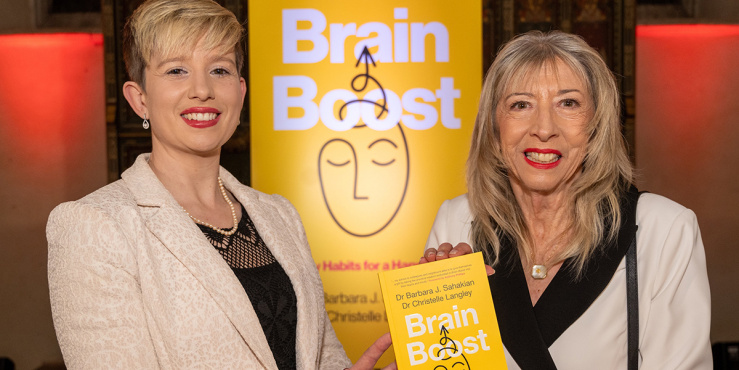
A User’s Guide to a Healthy Brain: Cambridge neuropsychology professor Dr. Barbara Sahakian’s leading research offers pathways to optimal mental health.
Photo: Brain Boost Launch (Dr Christelle Langley (left) and Professor Barbara Sahakian (right))
By Marie DeNoia Aronsohn
Recent Cambridge research linking menopause to diminished gray matter volume in the brain has been making headlines. Dr. Barbara Sahakian (Darwin), Professor of Clinical Neuropsychology in the Department of Psychiatry at Cambridge and a Fellow of Clare Hall, served as a senior researcher on the study. The work suggests that brain changes during menopause may help explain why many women experience mental health and neurological symptoms such as anxiety, depression, and memory problems—findings with potentially game changing implications for clinicians and individuals alike.
Dr. Sahakian has long been driven by a deep curiosity about brain health and how daily behaviors can influence the risk of dementia, depression, and other physical and psychological challenges.
Originally from Boston, she has published award winning books and hundreds of influential research papers, earning numerous accolades along the way. In 2024, she was awarded a CBE for Services to Research in Human Cognitive Processes. She is also a Fellow of both the British Academy and the Academy of Medical Sciences, and she is internationally recognized across the fields of psychopharmacology, neuropsychology, neuropsychiatry, neuroimaging, and neuroethics.
These distinctions only begin to capture the breadth of her distinguished career.
With this most recent research—and with the publication of Brain Boost: Healthy Habits for a Happier Life, coauthored with Dr. Christelle Langley and released last year by Cambridge University Press —Dr. Sahakian’s work is receiving increased mainstream attention. Brain Boost has quickly become one of her most popular books.
“Reception to the book has been great. Somebody told me the other day that they bought eight copies because they’re giving them as gifts,” said Dr. Sahakian.
At the heart of Brain Boost is a set of key lifestyle strategies for maintaining brain health, a scientific how-to guide to stay mentally sharp and emotionally well, grounded in Dr. Sahakian’s decades of research and expertise.
We spoke with Dr. Sahakian about her career, her focus on the power individuals have to bolster their own mental well being, and the scientific questions that most excite her today.
How can this latest research—linking changes in the brain to menopause symptoms—be most useful to women? What are the key takeaways?
“[The study shows] that women need to build cognitive reserve, and many are disadvantaged in doing so because they often have fewer opportunities to advance in their careers. We need to make it clear that women can counteract negative aspects of menopause through lifestyle and behavioral changes—improving diet, exercise, and sleep. It’s also important to keep the mind active through learning. If your job doesn’t challenge your brain, you need to find another way to do that.
I want to emphasize how incredibly important these steps are. We also need more research on hormone replacement therapy (HRT), including the dosage needed for effective treatment. I am concerned that some women are not receiving an effective dosage.”
In the U.S., HRT usage dropped sharply—was the same true in the UK?
“In the UK approximately 15% of women are on HRT, whereas this is only 5% in the US. Interestingly in Europe it varies greatly from 18% in Spain to 55% in France. Menopause symptoms vary widely between women in both the types and severity, with some reporting very low symptom burden and others reporting being significantly affected in their activities of daily life. Doctors have to consider a risk-benefit analysis when deciding to prescribe HRT for any individual woman.”
Your book Brain Boost, coauthored by Dr. Langley, is in many ways a guide for everyone. What inspired you both to write it?
“There were several motivating factors. I’ve noticed that people are very attentive to their physical health but far less tuned into their mental health—how they’re thinking and feeling. That’s really unfortunate. Early detection of mental health issues is crucial; people may have to wait a number of years to receive a diagnosis, for example for obsessive-compulsive disorder or ADHD. This may affect how well they respond to treatment, and ultimately their clinical outcomes.
So, I wanted people to become more aware of their mental health and cognition, to recognize that it’s just as important as physical health, and to be more proactive.”
What are some key takeaways for becoming more proactive about mental health?
“One study in the book shows that staying socially connected is vital. People who were socially isolated had a 26 percent increased risk of developing dementia. We also found that social isolation and loneliness were related to certain proteins involved in immune function. Another study found that acts of kindness are good for your brain: when people donated to a favorite charity while in a brain scanner, this activated their reward system. A key chemical in the brain in this reward system is dopamine.
We also looked at the impact of a healthy lifestyle. Good sleep and regular exercise can reduce the risk of depression by 57 percent.”
What area of research are you most excited to explore next?
“There are so many. I’m very interested in reading for pleasure—2026 is the UK's National Year of Reading, [a government-backed initiative aimed at reversing declining, for-pleasure reading rates]. Christelle and I hope to work with The Queen’s Reading Room to investigate adult reading habits and whether reading helps prevent dementia. I’m particularly interested in preventive psychiatry in order to reduce the risk of developing mental health disorders, such as depression, and neurological diseases, such as Alzheimer’s disease.
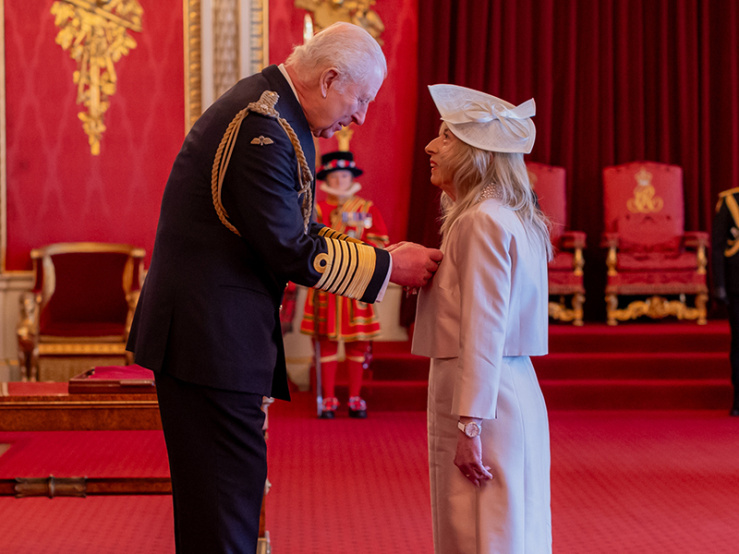
Professor Barbara Sahakian receiving the Commander of the Most Excellent Order of the British Empire for Services to Research in Human Cognitive Processes from His Majesty the King, Charles III, at Buckingham Palace in February 2025.