
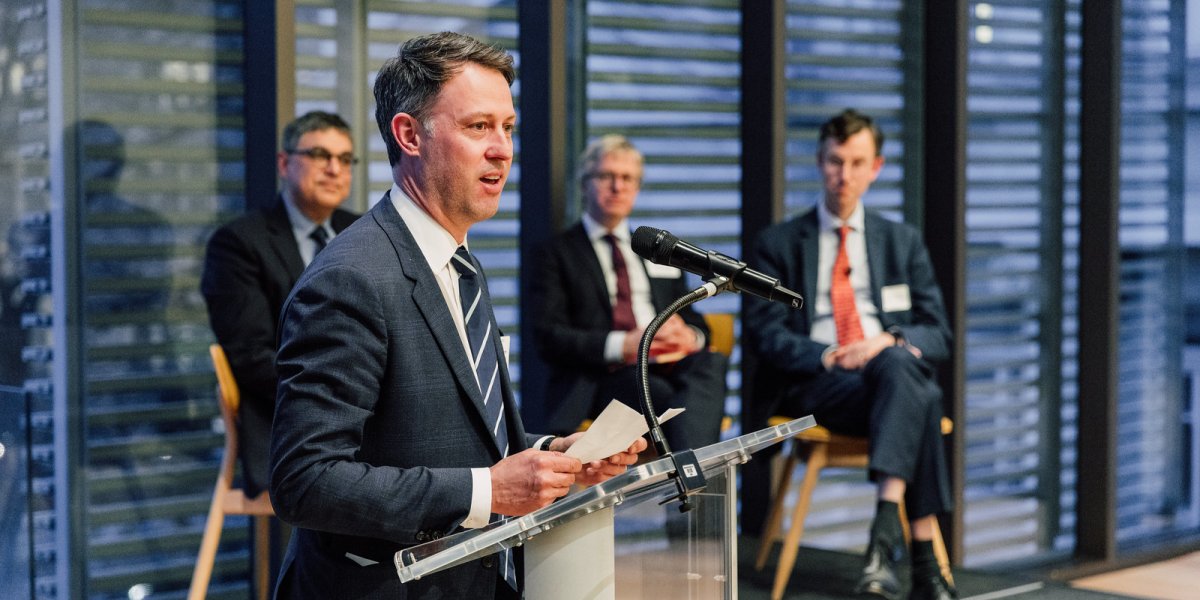
Middle Powers in a Fractured World: Cambridge alumni come together in Toronto to explore geopolitical disorder
The rules based international order—the longstanding agreement among nation states to play by common rules, so the world remains predictable, stable, and fair—is under unprecedented strain. For the middle powers that once found security beneath that framework, change is inevitable. That was the central message of a recent gathering hosted in Toronto by the Toronto Advisory Committee of Cambridge in North America.
“We’re meeting at a moment of accelerating geopolitical change,” said committee chair Henry Perren (Pembroke 1998). “It’s hard to keep up with the news cycle. Every story, every tweet, every post seems a little more inconceivable—or incoherent—than the last.”
The event featured two Cambridge scholars who offered cleareyed assessments of a rapidly destabilizing global landscape. Brendan Simms, Director of the Centre for Geopolitics at Cambridge, reflected on how dramatically the international environment has shifted in just three years. He described a “relentless assault on the rules-based order,” pointing to tariff wars, the Trump administration’s territorial posturing toward Greenland, and the open mockery of Canada as symptoms of a deeper transformation—one in which spheres of influence are displacing multilateral norms.
Simms also explored what he termed the Trumpian paradox: while the American president has done significant damage to Western credibility, he has simultaneously achieved what decades of diplomacy failed to accomplish—prompting NATO allies to dramatically increase defense spending. “Trump has, on the one hand, increased investment,” Simms observed. “On the other hand, he has crushed the brand.”
Still, Simms offered a note of cautious optimism. Ukraine’s unexpected resilience, he argued, has challenged assumptions about power asymmetry. Ukrainian innovation in drone warfare has enabled the country to hold its own against Russian forces far more effectively than many anticipated—even without full American backing.
Turning eastward, Dr. John Nilsson- Wright, Fuji Bank Professor of Japanese Politics and the International Relations of East Asia at Cambridge’s Faculty of Asian and Middle Eastern Studies (FAMES) and an Official Fellow at Darwin College, examined mounting anxiety in Japan and South Korea over American reliability. He cited striking polling data: 73 percent of Japanese voters and 70 percent of South Koreans doubt the United States would come to their defense in a crisis.
In response, both countries have embraced what Nilsson- Wright called strategic entrepreneurship—deepening ties with the United Kingdom, Europe, and each other, while rapidly expanding their own defense capabilities. He highlighted the Japan–UK–Italy Global Combat Air Programme (GCAP) fighter project and South Korea’s ambition to become the world’s fourth largest defense industrial producer as signs of a new and unapologetic assertiveness.
Yet Nilsson-Wright also warned of looming internal risks. Domestic populist movements—anti-immigrant, divisive, and highly adept at social media—pose a serious threat to the liberal democratic stability that underpins these emerging partnerships.
Both speakers invoked a remark by Canadian Prime Minister Mark Carney, who, this past January, declared at the World Economic Forum in Davos that the old-world order “is not coming back” and that “nostalgia is not a strategy.” The comment, which sparked headlines and heated debate in the aftermath of Davos, captured the prevailing mood of the evening: unsettled, unsentimental, and intent on confronting what comes next.