
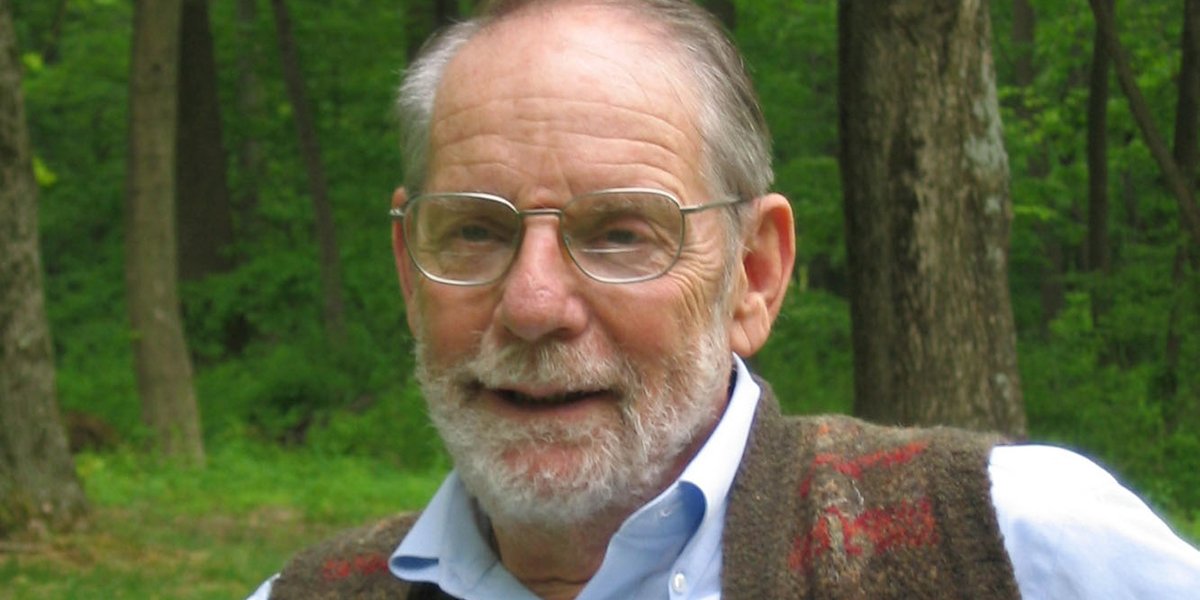
His way with words: The Legendary John McPhee (Magdalene 1953)
Photo Credit: Farrar, Straus and Giroux.
Author, journalist, and professor John McPhee (Magdalene 1953) is 95 years old, has written more than 30 books, is currently working on a new one, and continues to write for The New Yorker magazine. His list of prizes is long and includes a Pulitzer. A pioneer of creative nonfiction, in 2018 he received the National Book Critics Circle Award for Lifetime Achievement, one of the most prestigious honors in American literary culture. During his acceptance speech, he described the genre. "The creativity lies in what you choose to write about, how you go about doing it, the arrangement through which you present things, the skill and the touch with which you describe people and succeed in developing them as characters, the rhythms of your prose, the integrity of the composition...Creative nonfiction is not making something up but making the most of what you have,” said McPhee.
What does it mean to make the most of what you have? Reading McPhee is a master class in what to include in a piece of writing and what to leave out. New York Times Magazine staff writer Sam Anderson put it this way in a 2017 feature article, “What a more ordinary writer might say directly, McPhee will express through the white space between chapters or an odd juxtaposition of sentences. It is like Morse code: a message communicated by gaps.”
McPhee’s path to becoming a world-renowned writer began in Princeton, New Jersey. He grew up in the college town, attended Princeton High School, Princeton University, and spent 45 years teaching writing at Princeton. His time at Cambridge, a year at Magdalene College, was a brief period in the trajectory of his career. However, it held pivotal experiences. McPhee took time out to talk about his year at Cambridge and its reach into his extraordinary life. The following conversation has been edited for clarity and brevity.
You spent one year of undergraduate study at Cambridge after you received your degree from Princeton. What led you to do that?
After graduating from Princeton High School, I spent a year studying at Deerfield Academy in Massachusetts. Among my friends there was an English exchange student named Hal Doyne-Ditmas. At the end of that year, Hal and I hatched a plan. Since he would spend two years in the army, and then he would be going to Cambridge, I would try to go there after I received my degree from Princeton. And that's exactly what happened. Hal was at Magdalene College, and so that’s where I went in the fall of 1953.
Did your time at Cambridge influence you as a writer?
Over time, yes, but I didn’t write anything for publication when I was there. My academic supervisor was a guy named John Northam, who was at Clare. I had to write a paper for him every week. He would read it, and we would go over it. During the Michaelmas and Lent terms, I read a great deal. I read the whole of Shakespeare, for example. Literally down to the last comma.
Do you think of yourself as an alumnus of Cambridge?
I definitely think of myself as a person who spent a year at Cambridge after Princeton. And I'm awfully pleased to be addressed as a Cambridge alumnus. My memories of Cambridge are very positive. So, yes! And let me add: About a decade later, the first piece of writing that I ever managed to sell to The New Yorker was about Cambridge. It was called “Basketball and Beefeaters.”
Why basketball?
It was a peculiar thing. I was determined to soak up the English atmosphere. And so, what sport do I go out for? Basketball! As things developed, it was actually a wonderful way to be there. CUBBC – the Cambridge University Basketball Club. We traveled to London, Oxford, and the universities all over the Midlands. We were a strange group of people. We had players from the Caribbean, the Philippines. We had people from Wales. We had two or three English players and three Americans. It was not a mistake to play basketball at Cambridge, it's what made it such a fun year.
You spent 45 years teaching writing at Princeton University, famously launching the careers of dozens of renowned writers, including New Yorker editor David Remnick. What were some of the most fundamental lessons you conveyed to student writers?
One of my recent books is called “Draft No. 4.” It is dedicated to all my former students and contains the essence of everything I tried to pass along to them. A chapter called “Structure” is about planning the architecture of a piece of writing and actually derives from classes I had at Princeton High School, in which we had to write three compositions a week and defend their structures with outlines or drawings done before the writing. Structure in particular is something I pound at everybody because a high school teacher did that for me.
You’ve attended several of the most prestigious institutions in the world. Once, when asked which has had the greatest influence on you as a writer, you gave an interesting answer. What did you say?
I'd never heard that question before or certainly not before so large an audience. My head flashed from one to another of various institutions and I answered right back, saying “the children's camp I went to when I was six years old.” This camp was an educational institution, and it taught me about rocks and trees, woods and camping. Most of my books relate to subjects like those.
Throughout your life and career, you’ve taught many people many lessons. Through your writing you’ve given readers richly reported narrative nonfiction about the natural world, science, geography, and the people whose expertise shapes our understanding of them. As a writing professor you’ve taught generations of authors and journalists. How is it to be John McPhee at age 95?
It's a tough time, but it's also a revelation. I’m not 85 or 75 or 65 anymore. I'm 95 and my wife is 89. We're obviously in that last zone of life, but it's not unpleasant to describe. All day every day we are together. I'm so glad that things are the way they are at this age.